Cipher
Runs in your browser. Your text never leaves your device.
Atbash Cipher Translator
The Atbash cipher (mirror cipher, reversed alphabet) swaps A with Z, B with Y and so on.
Links carry your text after the # sign. Browsers never send that part of an address to a server, so it only reaches the people you share the link with.
Recent
Nothing yet. Your last 10 conversions, across every cipher, appear here. They are kept on this device only.
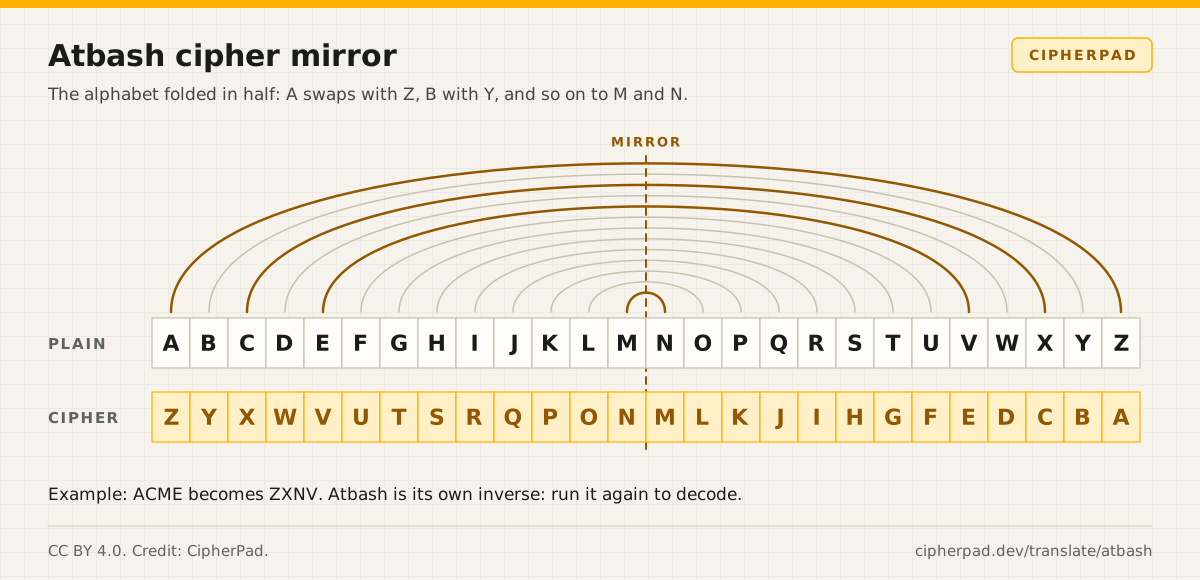
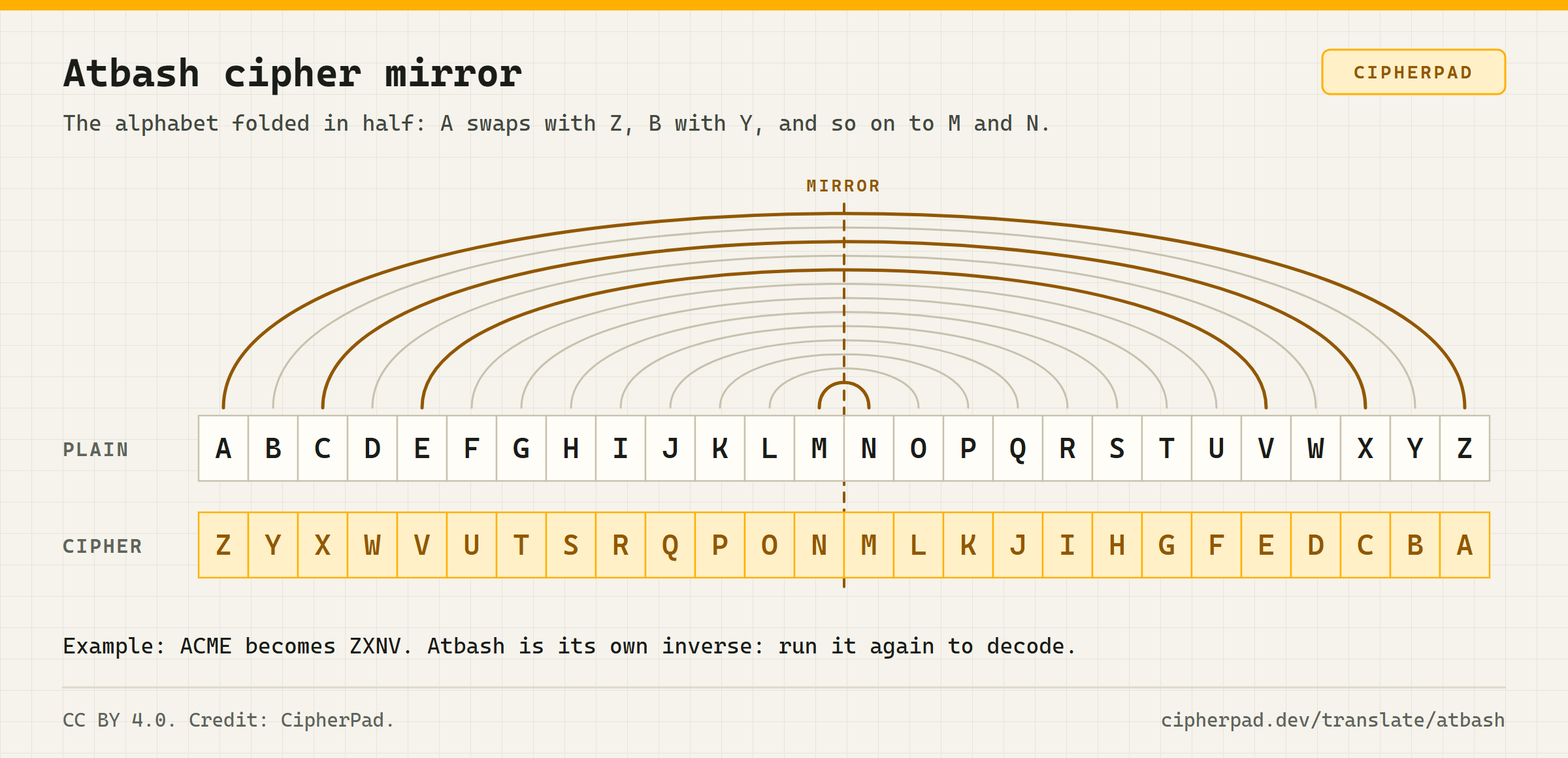
Atbash Cipher chart
Every letter at a glance. Use it to read or write by hand.
| Plain | A | B | C | D | E | F | G | H | I | J | K | L | M | N | O | P | Q | R | S | T | U | V | W | X | Y | Z |
|---|---|---|---|---|---|---|---|---|---|---|---|---|---|---|---|---|---|---|---|---|---|---|---|---|---|---|
| Atbash | Z | Y | X | W | V | U | T | S | R | Q | P | O | N | M | L | K | J | I | H | G | F | E | D | C | B | A |
Atbash Cipher at a glance
- Type
- Keyless cipher
- Key space
- None (fixed mirror)
- Directions
- Encode and decode: Text to Atbash and back
- Example
HELLO→SVOOL- Privacy
- Runs in your browser, nothing is uploaded
Paste a whole message and it flips through the Atbash alphabet at once, and you can share the result as a link that opens with your text already in place.
It is one of the oldest ciphers known and, like ROT13, it is its own inverse, so the same step encrypts and decrypts. It all runs on your device.
How the Atbash Cipher works
Each letter is replaced by its mirror counterpart. Think of the alphabet written forwards and backwards, one above the other: A over Z, B over Y, and read straight down.
Because the mapping is symmetric, encrypting an encrypted message returns the plain text. Non-letters are left alone.
Examples
History and origins
Atbash originated with the Hebrew alphabet and appears in the Hebrew Bible, where a handful of words are written in it. The name comes from the first, last, second and second-to-last Hebrew letters (aleph-tav-bet-shin).
Applied to the Latin alphabet it works the same way, flipping the letter order end to end. It is a favourite in puzzle hunts and geocaching for its simplicity.
Frequently asked questions
What is the Atbash cipher? #
Atbash is a substitution cipher that writes the alphabet backwards: A becomes Z, B becomes Y and M becomes N. It has no key, so ACME always becomes ZXNV.
How do I decode an Atbash cipher? #
Run the ciphertext through Atbash again. The mirror mapping is symmetric, so a second pass restores the original message.
What is the formula for the Atbash cipher? #
Counting A as 0, the letter at position p becomes the letter at position 25 - p. C is 2, so it becomes 23, which is X. Applying the same formula twice gives p back, which is why one step both encrypts and decrypts.
Does the Atbash cipher have a key? #
No. There is exactly one Atbash alphabet, so anyone who knows the method can read the message. Its secrecy lasts only as long as the reader does not recognise it.
What is the easiest cipher to decode? #
Atbash, because it has no key: one pass through the reversed alphabet reads it. The Caesar cipher comes next with 25 possible shifts, which a decoder tries in a fraction of a second.
Is Atbash the same as ROT13? #
No. ROT13 moves every letter 13 places forward, while Atbash mirrors the alphabet. Both undo themselves when applied twice, and they agree on only two letters: G and T swap places in both.
What does the name Atbash mean? #
It is built from four Hebrew letters: aleph and tav, the first and last, then bet and shin, the second and second to last. The name spells out the first two swaps of the cipher.
How old is the Atbash cipher? #
About 2,500 years. The Book of Jeremiah uses it, writing Sheshach for Babel, which makes Atbash one of the earliest substitution ciphers on record.
Learn more
Go deeper on the ideas behind this tool.
Not sure this is the right tool?
If you have a message and you are not certain what it is, the cipher identifier reads the character set and the letter statistics and tells you which scheme it most likely uses, and why. It covers every code and cipher on this site.
Related translators
Reference this tool
Mention this page in homework, a write-up or an article with this line:
Atbash Cipher Translator on CipherPad, retrieved on the date of your visit, https://cipherpad.dev/translate/atbash
The text on this page is licensed CC BY 4.0: you may share and adapt it, also commercially, as long as you credit CipherPad and link to the page.